

A car that won’t start doesn’t always need a new battery. A weak battery can cause starting trouble, but alternator or starter problems may produce similar symptoms. When your vehicle is stuck at home or work, driving it to a repair shop may not be practical. A mobile battery replacement service can bring diagnostic-led help to where it’s parked in Virginia, Washington, DC, or Maryland.
Before arranging a replacement, it helps to know what could be causing the problem and what to expect when a mechanic arrives. This guide covers common signs of a weak battery, how a mobile mechanic assesses starting and charging concerns, and what happens if replacement is the right repair. It also explains what information to share before the visit, so the mechanic can understand the issue and find your vehicle.
Key Takeaways
- Slow cranking, dim lights, or repeated starting trouble can point to a weak battery, but one symptom alone doesn’t confirm it needs replacement.
- A mobile battery replacement service can assess whether the issue may involve the battery, alternator, or starter before recommending a repair.
- A jump start may get a vehicle running temporarily, but it doesn’t identify why the car failed to start.
- Share your vehicle’s location, make and model, warning lights, and recent starting behavior to help prepare for an on-site visit.
- On-site diagnostics and repairs can help address a starting problem where your vehicle is parked in Virginia, DC, or Maryland.
Mobile battery replacement service: signs your car may need a new battery
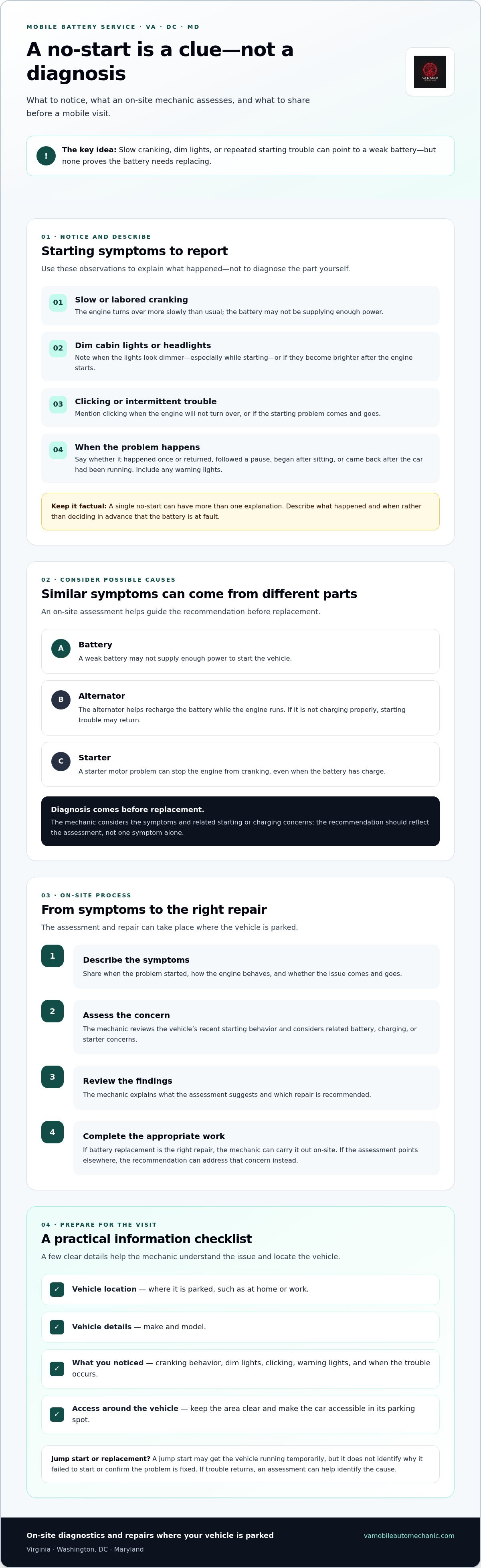
Slow cranking, dim lights, or repeated difficulty starting can point to a weak battery. You may notice the engine turns over more slowly than usual, or the interior and exterior lights look dimmer, especially when starting the car. These clues are useful to share with a mechanic, but none proves on its own that the battery needs replacement.
The battery supplies electrical power needed to start the vehicle and run its systems. The Automotive battery overview explains its basic purpose and design. Your car’s behavior can offer clues, but identifying the cause of a starting problem takes more than matching one symptom to one part.
Which starting problems can point to a weak battery?
A slow, labored engine crank may mean the battery isn’t supplying enough power. Dim cabin lights or headlights can also suggest an electrical issue, particularly if they become brighter after the engine starts. Clicking sounds may occur when the engine won’t turn over, and intermittent starting trouble can come and go. These signs have several possible causes, so treat them as observations rather than a diagnosis.
Note whether the problem happened once or has returned. A single no-start can have more than one explanation. Repeated slow starts, dimmer lights, or trouble that returns after the car has been running are details worth sharing. Describe what happened and when instead of deciding in advance that the battery is at fault.
A mobile battery replacement service brings an assessment to a vehicle parked at home or work. You don’t need to drive a car that won’t start to describe the problem. An on-site mechanic can assess the starting concern and related charging or mechanical issues before recommending a repair.
Could the alternator or starter be causing the same symptoms?
The alternator helps recharge the battery while the engine runs. If it isn’t charging properly, the battery may lose power and starting trouble can return. A starter motor problem can also stop the engine from cranking, even when the battery has charge. Similar symptoms can have different mechanical causes, so a no-start doesn’t automatically mean the battery is bad.
Pay attention to the pattern: whether the car starts after a pause, whether the trouble repeats, and whether warning lights appear. These details help the mechanic understand what the vehicle is doing. On-site diagnostics and repairs can address the problem where the car is parked, at home or work, across Virginia, Washington, DC, and Maryland.
How mobile battery replacement works, from diagnosis to installation
A mobile battery replacement service brings the mechanic to the vehicle, so assessment and repair can take place where it’s parked. The process is straightforward: describe what’s been happening, let the mechanic assess the starting concern, review the findings and recommended repair, then have the work completed if battery replacement is appropriate.
- Describe the symptoms: Share when the problem started, how the engine behaves, and whether the issue comes and goes.
- Assess the cause: The mechanic considers the vehicle’s symptoms and related starting or charging concerns.
- Review the next step: The mechanic explains what the findings suggest and which repair is recommended.
- Complete the work: If replacement is the right repair, the mechanic can carry it out on-site.
What happens during an on-site battery assessment?
The mechanic reviews your description and the vehicle’s recent starting behavior, then assesses the concern at the parked vehicle. A weak battery, a charging issue, or a starter problem can affect starting in similar ways. The recommendation should reflect the assessment findings, not one symptom alone. The steps involved depend on the vehicle and the problem.
For example, tell the mechanic if the car started normally after one attempt but struggled again later, or if the problem began after the vehicle had been sitting. This context helps with the on-site assessment and with identifying whether the issue points to the battery or another part of the starting or charging system.
What should a driver expect during battery replacement?
Before work begins, the mechanic explains the findings and proposed repair. If replacement is recommended, the mechanic accesses the vehicle and battery area to complete the work. You don’t need to handle battery connections yourself. Keep the area around the vehicle clear and make the car accessible in its parking spot so the mechanic can work safely.
After the work, the mechanic can explain what was done and any relevant next steps. If the assessment points to a different cause, the repair recommendation can address that concern instead of replacing a battery unnecessarily. Diagnosis should come before replacement, because the same starting complaint can come from different parts of the vehicle.
VA Mobile Auto Mechanic provides on-site diagnostics and repairs at homes and workplaces across Virginia, Washington, DC, and Maryland. If your vehicle is parked and won’t start, you can arrange mobile mechanic service for an on-site assessment.
Jump start or mobile battery replacement: how to tell what may help
A jump start and a battery replacement serve different purposes. A jump start attempts to get a vehicle running; it doesn’t show why the car failed to start or confirm that the problem is fixed. A no-start doesn’t automatically mean the battery needs replacing, either. If the trouble returns, an assessment can help identify whether the cause involves the battery, alternator, starter, or another related issue.
| Option | What it may do | What it won’t tell you |
|---|---|---|
| Jump start | May help the vehicle start temporarily. | Doesn’t identify the cause of the starting problem. |
| Battery replacement | Replaces the battery when findings indicate it’s the appropriate repair. | May not address a separate alternator or starter fault. |
| Diagnostic-led mobile repair | Assesses the starting concern at the vehicle’s location and guides the repair recommendation. | Doesn’t assume every no-start requires a new battery. |
When might a jump start be enough for the moment?
A jump start may be a temporary way to attempt restarting a vehicle that won’t start after being parked. If the engine turns over afterward, note whether it starts again later and whether the original symptoms return. A successful restart alone doesn’t prove the battery is healthy or that the underlying issue has been resolved.
If the car starts but struggles again after being parked, keep track of that pattern. Repeatedly relying on a jump start can leave the cause unaddressed, so treat it as a clue to share during an assessment rather than a lasting repair.
When should the problem be diagnosed instead of repeatedly jump-started?
Recurring no-starts call for a closer look at the battery and related systems. A battery may not be holding or receiving charge as expected, while an alternator concern can affect charging. A starter problem can also prevent the engine from cranking. Because these issues can produce similar symptoms, diagnosis helps guide the next repair instead of relying on guesswork.
A mobile battery replacement service brings on-site diagnostics and repairs to a vehicle parked at home or work. Share how often the trouble happens and what changes after a jump start. For more on preparing for work at a parked vehicle, see this driveway auto repair guide.
How to prepare for a mobile battery replacement visit in Virginia, DC, or Maryland
A few details before the visit help the mechanic understand the starting problem and locate the vehicle. For a mobile battery replacement service at home or work, share the vehicle’s exact location and what it has been doing. You don’t need to identify the cause. A clear description gives the mechanic useful context for an on-site assessment.
What information should you have ready when arranging service?
Have these details ready when you arrange service:
- Vehicle: Make and model, plus any other identifying details you know.
- Location: Where the vehicle is parked, such as a driveway, workplace lot, or parking garage.
- Symptoms: Describe whether the engine cranks slowly, clicks, or doesn’t respond when you try to start it.
- Recent history: Mention warning lights, any recent jump start, and whether the difficulty starting has happened before.
Include the pattern, too. For example, note whether the car started normally on some attempts or whether the trouble returned after a jump start. These observations help guide the assessment without assuming battery replacement is the only possible repair.
How can you make the parked vehicle easier to service?
Choose a parking spot where the mechanic can safely reach the vehicle and work around it. If practical, leave clear space near the car and its battery area, and share any access instructions for a gated lot or workplace parking area. Home and work locations can both suit on-site service as long as the vehicle is accessible.
VA Mobile Auto Mechanic provides on-site diagnostics and repairs in Virginia, Washington, DC, and Maryland. Another example of work handled at a vehicle’s location is described in this mobile brake repair overview.
Once you have the vehicle details, symptoms, and parking information ready, arrange on-site battery service for your parked vehicle.
Arrange mobile battery replacement service with VA Mobile Auto Mechanic
If your car won’t start, you don’t have to assume the battery is the cause or try to drive it to a repair shop. VA Mobile Auto Mechanic provides on-site diagnostics and repairs at homes and workplaces across Virginia, Washington, DC, and Maryland. A mobile battery replacement service can begin with an assessment at the vehicle’s location, followed by a repair recommendation based on the mechanic’s findings.
What makes on-site mechanic service practical for battery trouble?
When a vehicle won’t start, getting it to a shop can be difficult. On-site service brings the mechanic to where it’s parked, whether that’s your driveway or workplace parking area. The mechanic can assess the starting concern there and consider whether it points to the battery or a related issue. That gives you a clearer basis for deciding which repair to proceed with.
Describe what you’ve noticed and let the assessment guide the next step. A new battery may be appropriate, but a starting or charging concern can have another cause. On-site diagnostics and repairs keep the process focused on the vehicle’s symptoms without requiring you to drive a disabled car for an initial assessment.
What is the next step if your car will not start?
When arranging service, share where the vehicle is parked and describe what happens when you try to start it. Include whether the engine cranks, whether you hear clicking, and whether the problem has happened before or returned after a jump start. These details help the mechanic understand the concern and assess it at the vehicle.
VA Mobile Auto Mechanic serves customers at home or work in Virginia, Washington, DC, and Maryland. After the on-site assessment, use the mechanic’s findings to determine whether battery replacement or another repair is the appropriate next step. This grounds the decision in the vehicle’s condition rather than a guess based on one symptom.
If your vehicle is parked and won’t start, arrange mobile mechanic service for an on-site assessment.
Take the next step with on-site battery help
Slow cranking or repeated starting trouble can point to a weak battery, but symptoms alone don’t confirm what needs repair. A jump start may get the car going temporarily without explaining why it failed to start. A mobile battery replacement service can begin with an on-site assessment, so the mechanic can consider the battery and related starting or charging concerns before recommending what to do.
VA Mobile Auto Mechanic provides diagnostics and mechanical repairs where your vehicle is parked, at home or work across Virginia, Washington, DC, and Maryland. Share the vehicle’s location and describe what happens when you try to start it. Those details help set up a practical next step without driving a disabled car to a shop.
Arrange mobile mechanic service at your location for an on-site assessment. With clear information and an evaluation at the vehicle, you can move forward with a better understanding of the starting trouble.
Frequently Asked Questions
Can a mobile mechanic replace a car battery at my home or workplace?
Yes. VA Mobile Auto Mechanic provides on-site diagnostics and mechanical repairs at homes and workplaces across Virginia, Washington, DC, and Maryland. A mechanic can assess the starting problem where the vehicle is parked and recommend a repair based on the findings. If battery replacement is appropriate, the work can be handled on-site, so you don’t need to drive a car that won’t start to a repair shop.
How do I know if my car needs a new battery or a jump start?
A jump start may help the car start temporarily, but it doesn’t confirm that the battery is the cause or that the problem is fixed. Slow cranking, dim lights, or repeated starting trouble are useful details to share, but symptoms alone can’t establish that you need a new battery. If starting problems return, arrange an assessment to help determine whether replacement or another repair is appropriate.
Can an alternator problem look like a dead battery?
Yes. An alternator problem can affect how the battery charges and may lead to starting trouble or a battery that seems to have lost power. A starter motor concern can also prevent the engine from cranking. Similar symptoms can have different mechanical causes, so a no-start doesn’t automatically mean the battery has failed. On-site diagnostics can help assess the battery and related starting or charging issues.
What information should I provide when booking mobile battery replacement?
Share the vehicle’s location, make and model, and a clear description of what happens when you try to start it. Mention warning lights, slow cranking or clicking, and whether the issue has happened before. If you’ve tried a jump start, include whether it helped and if the trouble returned. These details help the mechanic understand the concern and prepare for an on-site assessment.
Can a mobile mechanic diagnose a car that will not start?
Yes. VA Mobile Auto Mechanic provides on-site diagnostics for vehicles at home or work across Virginia, Washington, DC, and Maryland. Describe what the car does when you try to start it, including whether the engine cranks or you hear a clicking sound. The mechanic can assess the concern and consider possible battery, alternator, or starter issues before recommending a repair.
Does mobile battery replacement service include towing?
No. VA Mobile Auto Mechanic does not provide towing services. Mobile mechanics travel to the vehicle’s location to perform on-site diagnostics and mechanical repairs, so you can arrange help for a car parked at home or work without driving it to a shop. Share where the vehicle is parked and describe the starting problem when arranging mobile mechanic service in Virginia, Washington, DC, or Maryland.


